
Remote Ingress in Industrial Cold-Chain Networks
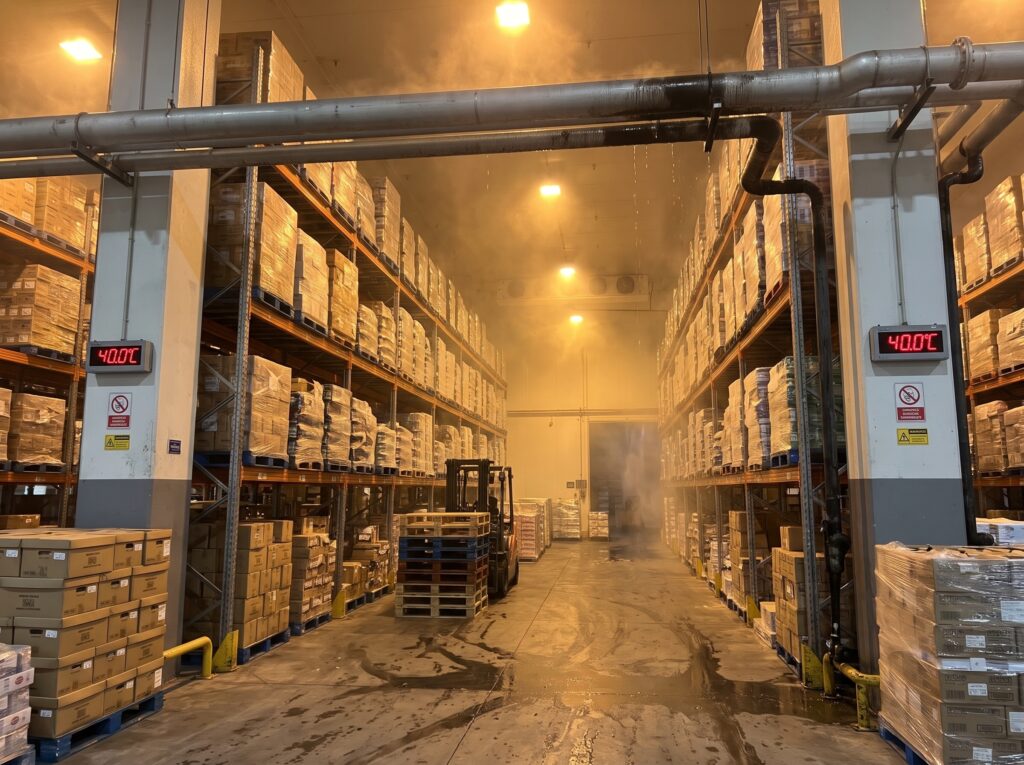
Across a series of cold-chain breaches in Europe, attackers didn’t deploy destructive malware to threaten inventory—they simply used remote monitoring channels to push unauthorized setpoint overrides directly into active refrigeration controllers. By raising temperature limits and defrost intervals, unauthorized access to low-level control loops can spoil pharmaceuticals, disrupt critical blood supplies, ruin perishable food inventory, and damage mechanical compressors. In short, compromising a passive telemetry link is all it takes to trigger physical product loss.
While alarms and rapid manual intervention prevented catastrophic product loss during the November 2026 incidents at the French Blood Establishment (EFS), relying on human operators to catch live setpoint tampering is not a sustainable operational strategy. Cold-chain infrastructure requires an architecture that makes unauthorized inbound manipulation physically impossible.
When Remote Telemetry Becomes Remote Control
The intrusion path observed across these cold-chain disruptions points to an architectural vulnerability common in distributed utilities and cold logistics: third-party monitoring connections.
In cold storage facilities, food processing plants, and pharmaceutical distribution centers, distributed refrigeration racks run specialized industrial protocols such as Modbus TCP/RTU, BACnet/IP, or proprietary fieldbuses. These controllers regularly report evaporator temperatures, suction pressures, compressor runtime, and alarm states outward to central building management systems (BMS), energy management dashboards, and OEM cloud platforms.
In several reported cases, unauthorized control was achieved not by penetrating the facility’s core enterprise network, but through third-party management gateways, legacy controller interfaces, and exposed maintenance links. Attackers leveraged these paths to push parameter overrides directly into local controllers, raising storage temperatures and altering defrost intervals.
From a network engineering perspective, the underlying issue is architectural conflation: the channel built for telemetry export was also capable of inbound control. When these channels share a standard bi-directional firewall or VPN tunnel, operational control is directly exposed. If management credentials are stolen, a VPN appliance suffers an exploit, or a cloud portal is breached, the pathway back down into the physical refrigeration loop is wide open.
Total Visibility vs. Zero Inbound Reachability
Cold-chain operations face an apparent contradiction between business demands and security requirements. Energy optimization, regulatory compliance (such as FDA 21 CFR Part 11 or food safety temperature logs), and automated billing require real-time data streaming to external platforms. Yet process safety requires that no external cloud platform or remote third party has unverified write access to compressor cutoff thresholds, expansion valves, or defrost timers under any operational condition.
Software firewalls cannot resolve this contradiction deterministically. Running on general-purpose hardware, any single misconfiguration, zero-day vulnerability in routing software, or session-hijacking attack has potential to turn an outbound monitoring channel into an inbound attack route.
A data diode resolves this conflict at the physical layer. By utilizing a physical transfer mechanism that transmits data in one direction, the hardware eliminates the return path an attacker needs to modify setpoints or disable cooling routines.
Solving the Industrial Polling Challenge
Deploying unidirectional boundaries in refrigeration networks surfaces a specific technical hurdle: industrial refrigeration equipment relies on specialized request-response polling protocols such as Modbus TCP, BACnet/IP, serial RTU bridges or proprietary fieldbuses. Often, these protocols depend on two-way handshakes: a supervisory master queries a register, and the controller responds with the value. A field controller cannot simply broadcast its registers over a raw, unmanaged one-way physical link without receiving polling requests.
BlackBear intelligent unidirectional gateways overcome this through integrated protocol proxying:
1. Local OT Ingestion: An internal proxy sits inside the isolated refrigeration network, acting as an authorized client/master. It locally queries the refrigeration PLCs, rack controllers, and temperature probes over native protocols (Modbus, BACnet, OPC UA).
2. Hardware-Enforced Separation: The internal unit extracts the operational metrics, terminates the local network session, and streams the raw payload across the hardware-enforced one-way boundary.
3. External Replication: An external proxy running on the destination network receives the data stream and populates a mirrored data instance. Remote monitoring platforms, cloud databases, and OEM portals query this external mirror via standard modern interfaces (such as MQTT, REST APIs, or mirrored OPC UA servers).
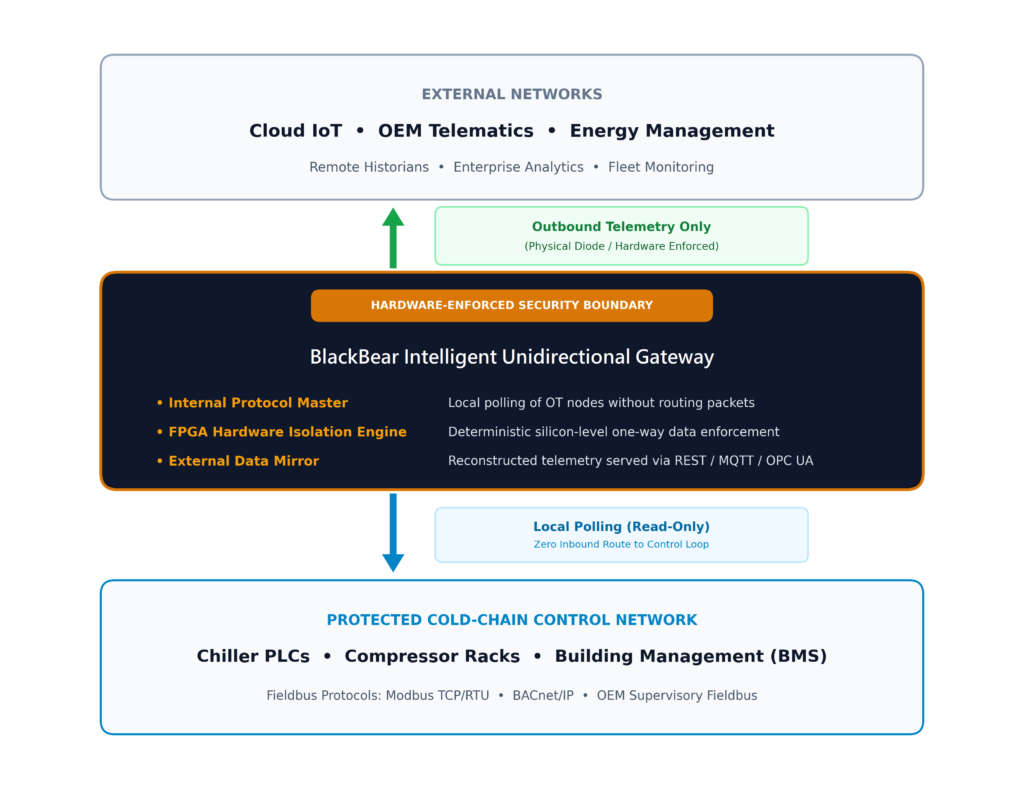
External platforms receive real-time temperatures, compressor metrics, and alarm states with sub-second fidelity. However, because the communication channel is physically one-way, no packet, command, or register write can physically traverse back to the physical controller.
Decoupling Continuous Telemetry from Maintenance Ingress
Another dilemma that refrigeration networks face is supporting routine vendor maintenance: If the telemetry export path is strictly unidirectional, how do technicians perform remote tuning, seasonal setpoint recalibration, or firmware patching?
The solution is to separate continuous monitoring from episodic maintenance.
Operational telemetry remains consistently unidirectional. But vendor servicing must be controlled and transient. Control changes and firmware updates should never rely on an open, persistent maintenance connection. When remote intervention is required, it must take place over a separate, highly controlled path: activated on demand, secured by multi-factor authentication, monitored via recorded jump-host sessions, and backed by a physical hardware lockout.
By decoupling everyday data export from occasional maintenance access, the network architecture eliminates the risk that a vulnerability in a vendor’s remote monitoring platform can be weaponized against local cooling equipment.
Building Deterministic Cold-Chain Defenses
Software and alarms are helpful in lowering and detecting, but not in removing, the risk of exposure. When digital setpoints directly dictate physical product integrity, deterministic boundaries are imperative.
BlackBear’s unidirectional gateway solutions use hardware to ensure data leaves the plant while keeping critical controllers unreachable from the outside world. Examine specific network architectures and integration topologies for temperature-controlled facilities in our engineering breakdown on securing cold-chain operations with BlackBear intelligent gateways.